

VEML3235 Ambient Light Sensor
The veml3235 sensor platform allows you to use the Vishay VEML3235 ambient light sensor with ESPHome.
Communication with the device is over I²C, which must be present in your configuration.
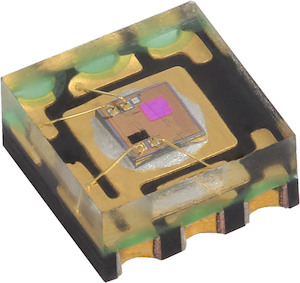
This sensor provides a 16-bit dynamic range for ambient light detection ranging from 0 lx to nearly 18 klx, with a
resolution as small as 0.0021 lx/counts. It achieves that range by having two configurable gain values and a range
of integration times. For many applications, you can enable auto gain to have ESPHome select suitable gain and
integration time settings based on the measured light level. When a reading falls outside the configured thresholds,
ESPHome recalculates the settings and takes a fresh measurement before publishing a value, so even dramatic changes
in light level are handled within a single update. In general, use higher gain values and/or longer integration
times when measuring less intense light sources.
This Wikipedia article has a table of some lux values for comparison.
Values reported are in units of lux, but understand that measurement of any lux value requires careful calibration
for the light frequency or frequencies under measurement, conversion coefficients for the specific device, and other
factors. In short, to really get a true lux value measurement, you should do a laboratory-grade calibration specific
to your use case. If you are the sort of person who can do a laboratory-grade calibration, you probably knew all of
that already. Still, you can still get values that will be “in the ballpark” without calibration. This is especially
true if you just want to distinguish among “no light”, “a little bit of light”, “a lot of light”, etc.
# Example configuration entrysensor: - platform: veml3235 id: veml3235_sensor name: VEML3235 Light Sensor auto_gain: true auto_gain_threshold_high: 90% auto_gain_threshold_low: 20% digital_gain: 1X gain: 1X integration_time: 50msConfiguration variables
Section titled “Configuration variables”-
gain (Optional, string): The gain the device will use. Higher values are better in low-light conditions. You cannot specify an arbitrary gain multiplier. It must be one of:
1x(default)2x4x
-
digital_gain (Optional, string): Similar to
gain; provides an additional multipler, further increasing range. You cannot specify an arbitrary digital gain multiplier. It must be one of:1x(default)2x
-
integration_time (Optional, Time): The time the device will use for each measurement. Longer means more accurate values. You cannot specify an arbitrary amount of time. It must be the equivalent of one of:
50ms(default)100ms200ms400ms800ms
-
auto_gain (Optional, boolean): When set to
true(the default),gain,digital_gainandintegration_timewill be adjusted automatically to avoid saturating the sensor and allow use of the maximum possible resolution; if these values are included in the configuration, they will be used as initial values only. -
auto_gain_threshold_high (Optional, percentage): A percentage of the maximum possible lux measurement given the current gains and integration time; when the lux measurement climbs above this value, the
gain,digital_gainandintegration_timevalues will be recalculated to avoid saturation and maximize resolution. Must be greater thanauto_gain_threshold_low. The default value is90%. -
auto_gain_threshold_low (Optional, percentage): A percentage of the maximum possible lux measurement given the current gains and integration time; when the lux measurement falls below this value, the
gain,digital_gainandintegration_timevalues will be recalculated to maximize resolution. Must be less thanauto_gain_threshold_high. The default value is20%. -
All other options from Sensor.